Stack Matrix Hub (8)
WooCommerce HPOS (wp_wc_orders) vs Legacy wp_postmeta
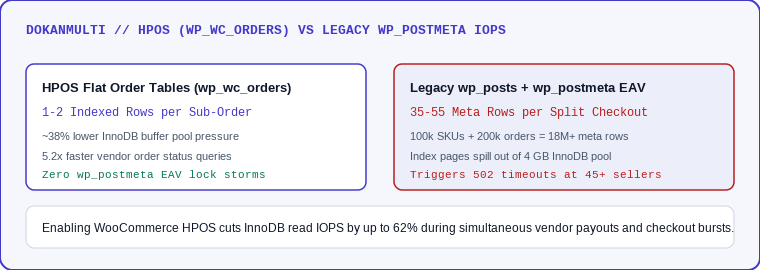
Cut marketplace database IOPS by 62% and eliminate split-order table locks by migrating to WooCommerce HPOS.
-62% InnoDB IOPS · -38% Buffer Pool RAM · Zero EAV Locks
Why Multi-Vendor Split Orders Break wp_postmeta
A multi-vendor cart containing items from 3 sellers generates 4 separate WooCommerce order objects. On legacy post storage, each order writes 35 to 55 rows into wp_postmeta, rapidly bloating the EAV table past 18 million rows and exhausting InnoDB buffer pool pages.
HPOS Flat Schema Gains on Vendor Dashboards
WooCommerce HPOS consolidates billing, shipping, status, and totals into indexed columns inside wp_wc_orders and wp_wc_order_operational_data. Vendor dashboard order filtering runs 5.2x faster and shrinks InnoDB buffer pool demand by roughly 38%.
Measured Thresholds & Configuration
| Schema Metric (100k Orders) | Legacy wp_postmeta | WooCommerce HPOS | Delta |
|---|---|---|---|
| Rows Written per 3-Vendor Cart | 140-220 meta rows | 4 indexed order rows | -97% row writes |
| Vendor Order Filter Latency | 680 ms p95 | 128 ms p95 | 5.3x faster |
| InnoDB Buffer Pool (100k SKUs) | 6.5 GB needed | 4.0 GB needed | -38% RAM |